Comparative evaluation of soil moisture measurement methods under crop rotation across three irrigated locations in Kano and Jigawa States, Nigeria
Abstract
Accurate soil moisture measurement is essential for efficient irrigation management and sustainable crop production. This study evaluated the performance of Time Domain Reflectometry (TDR) and a portable moisture meter relative to gravimetric method across three irrigated locations (BUK, HVIP and KRIP) during the rainy and cold dry seasons. Soil moisture data were collected under crop rotation systems, and method performance was assessed using descriptive statistics, root mean square error (RMSE) and coefficient of determination (R2). Results revealed clear seasonal and spatial variability in soil moisture. Gravimetric mean moisture content ranged from 13.9% to 23.7% during the cold dry season and from 16.7% to 21.7% during the rainy season across locations. TDR generally exhibited stronger agreement with gravimetric measurements, with R2 values ranging from 0.299 to 0.844 and comparatively lower RMSE values. In contrast, the portable moisture meter showed greater variability, with weaker correlations at certain locations (R2 as low as 0.042) and higher prediction errors. The findings indicate that TDR provides more reliable soil moisture estimates under the studied conditions, although sensor performance varied by location and season. Site-specific calibration is therefore recommended to improve the accuracy of electronic soil moisture monitoring tools for irrigation management.
Keywords: Soil water monitoring, Time Domain Reflectometry, Portable moisture meter, Irrigating scheduling, Gravimetric method, Sensor calibration, Seasonal variability, Irrigated agriculture
INTRODUCTION
Soil moisture is one of the most critical determinants of crop growth, water-use efficiency and sustainable agricultural production in irrigated farming systems. It regulates nutrient availability, influences soil temperature and effects several physiological and biochemical processes essential for crop performance (Hillel, 2013; Jury and Horton, 2004). In semi-arid regions such as northern Nigeria characterized by high evapotranspiration and seasonal rainfall accurate monitoring of soil moisture is vital for optimizing irrigation management and achieving stable crop yields (Adebayo et al., 2019; Umar et al., 2021; Sani et al., 2023). As irrigation agriculture continues to intensify across Kano and Jigawa States, particularly within long-standing crop-rotation systems, the need for reliable and cost-effective soil moisture measurement methods has become increasingly essential (Sani et al., 2026).
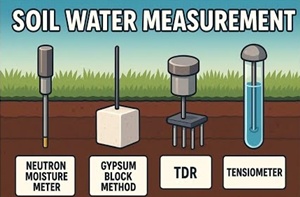
Several methodological options exist for soil-moisture determination, each with unique operational principles, strengths and limitations. The gravimetric method, although widely regarded as the reference standard due to its direct measurement of soil water content, is destructive, labour-intensive, and unsuitable for real-time or continuous monitoring (zhang et al., 2018). In contrast, modern techniques such as time domain reflectometry (TDR), tensiometers, gypsum blocks and capacitance sensors offer rapid, non-destructive readings but vary in accuracy, sensitivity to soil texture and salinity, calibration meeds, and field robustness (Evett et al., 2006; Robinson et al., 2008). Hence, field-based comparative evaluation is necessary to identify methods that perform reliably under local soil and environmental conditions.
Crop-rotation systems commonly practiced in northern Nigeria especially cereal-legume sequences introduce variability in root distribution, evapotranspiration and soil moisture, all of which influence soil moisture dynamics (Ibrahim et al., 2020; Lal, 2015). Furthermore, the irrigated landscapes of Kano and Jigawa states contain diverse soil types ranging from sandy loam to clay loam, with distinct hydraulic properties that may affect the readings of moisture measurement devices (Olanrewaju et al., 2017; Sani et al., 2022). Despite the importance of soil moisture data for irrigation scheduling, fertilizer management and yield optimization, empirical studies comparing the performance of major soil moisture measurement methods across multiple irrigated sites in these states remain limited.
Therefore, this study conducts a comparative evaluation of selected soil moisture measurement methods across three irrigated locations in Kano and Jigawa States. Specifically, it examines the precision, reliability and field suitability of gravimetric, TDR and portable moisture meter methods under varying soil textures and crop-rotation systems. The results are expected to guide farmers, irrigation managers and researchers in selecting appropriate techniques that enhance water-use efficiency, promote sustainable irrigation practices and support data-driven decision-making in semi-arid agricultural environments.
MATERIALS AND METHODS
Study Area
The study was conducted at three irrigated locations within the Sudan Savanna agro-ecological zone of northern Nigeria, namely the Hadejia Valley Irrigation Project (HVIP) in Jigawa State, the Kano River Irrigation Project (KRIP) in Kano State and Bayero University Kano (BUK) Orchard. The geographical extent of the study sites lies within latitudes 11.64o – 12.38o N and longitudes 8.41o – 9.98o E. the region is characterized by a semi-arid climate with a unimodal rainfall pattern and three distinct seasons: the rainy season (June-September), cold dry season (October – February) and hot dry season (March – May). The soils across the study locations are predominantly alluvial to sandy loam in texture, typical of irrigated floodplain environments, with moderate drainage characteristics and variable organic matter content. Rainfall is seasonal, while irrigation supports intensive year-round crop production. Farming systems in the study areas operate a triple-season cropping pattern involving cereals, legumes, vegetables and fallow periods under different crop-rotation arrangements (Musa et al., 2025).
Crop rotation was implemented continuously for two consecutive seasons prior to soil-moisture evaluation. Soil-moisture measurements were conducted during the second year of rotation, specifically in the rainy and cold dry seasons, corresponding to periods of active crop growth and irrigation management. Although cropping activities also occurred during the hot dry seasons, soil moisture data were not collected during this period due to the defined scope of the study. Crop rotation was treated as a field management descriptor rather than an experimental treatment and was used to contextualize soil moisture dynamics across locations.
Experimental Design
The study adopted a fractional factorial experimental design to evaluate and compare soil-moisture measurement methods across locations and seasons under field conditions. The experimental factors included three locations, two seasons (rainy and cold dry), and three soil-moisture measurement methods. Due to logistical constrains associated with on-farm irrigated systems, the experiment was conducted without replication.
At each location, all soil-moisture measurement methods were applied on the same sampling dates and at the same sampling points to ensure direct comparability and to minimize temporal variability. Soil-moisture measurements were carried out six times per season at each location, covering different stages of crop growth and irrigation cycles.
Soil Moisture Measurement Methods
Three soil-moisture measurement methods were evaluated in this study: the gravimetric method, time domain reflectometry (TDR) and a portable soil-moisture meter.
The gravimetric method was used as the reference technique. Soil samples were collected using core sampler from the soil surface down to the effective root-zone depth of the crops. The samples were immediately sealed in airtight containers and transported to the laboratory. Fresh weight were recorded prior to oven-drying at 105oC to constant weight. Gravimetric soil-moisture content was calculated as the ratio of water loss to oven-dry soil weight and expressed as percentage (%).
Soil moisture content was also measured in situ using a time domain reflectometry (TDR) device. The TDR probes were inserted vertically into the soil within the same sampling points used for gravimetric sampling covering the surface-to-root-zone depth. Measurement were taken following the manufacturer’s operational guidelines.
In addition, a portable soil-moisture meter, consisting of metal rods connected to a handheld display unit, was used to obtain instantaneous soil-moisture readings. The rods were inserted into the soil to the root-zone depth at the same sampling locations, and reading were recorded directly as percentage values. All three measurement methods were applied on the same day and under identical field conditions to ensure consistency and comparability.
Sampling Depth and Frequency
Soil-moisture measurements were restricted to the surface-root zone, representing the active zone of water uptake by crops under irrigated conditions. This depth was selected to ensure relevance to crop water availability and irrigation scheduling. Sampling was conducted six times per season during both the rainy and cold dry seasons at each location. Relatively high soil-moisture values recorded during some sampling periods reflect measurements taken shortly after irrigation events, particularly in fine-textured alluvial soils characteristics of the study sites.
Crop Rotation Classification
Crop rotation was defined as the sequence of crops grown during the rainy season followed by the cold dry season and was practiced for two seasons prior to soil-moisture assessment. Soil-moisture measurements were carried out during the second year of rotation, allowing effects of established cropping sequences and field management practices to be reflected in soil-water conditions.
Crop rotation was not treated as an experimental factor but was used to describe prevailing field management practices and to support interpretation of soil-moisture variability across locations and seasons.
Statistical Analysis
Soil-moisture values obtained from the TDR and portable moisture meter were evaluated against the gravimetric method using method-comparison performance indicators, including the coefficient of determination (R2) and root mean square error (RMSE). A small number of soil-moisture observations were missing due to field limitation. These missing values were not imputed; instead, statistical analyses were conducted using paired observations only, and missing data were excluded on a case-by-case basis.
Data Screening and Quality Control
Prior to statistical analysis, all soil moisture data were screened for completeness and consistency. Observed zero (0.00) values recorded by the electronic sensors were retained in the dataset where they represented actual instrument readings under very low moisture conditions or sensor detection limits. No artificial replacement or imputation was performed to avoid biasing the statistical evaluation of sensor performance. Paired comparisons between electronic methods and the gravimetric method were conducted only where complete observations were available. The presence of extreme or zero values was considered during interpretation of the results, as electronic sensors may exhibit reduced sensitivity under very dry soil conditions.
RESULTS
Descriptive Statistics of Soil Moisture
The descriptive statistics of soil moisture content measured using the gravimetric method, Time Domain Reflectometry (TDR), and portable moisture meter across the three study locations (BUK, KRIP and HVIP) during the rainy and cold dry seasons are presented in Table 1.
At BUK, mean gravimetric soil moisture was 21.7% during the rainy season and increased to 23.7% during the cold dry season. The portable moisture meter consistently recorded higher values, with means of 30.5% and 33.0% in the rainy and cold dry seasons, respectively, indicating overestimation of approximately 39-4% relative to the gravimetric method. TDR values (19.7% and 16.0%) were closer to gravimetric measurements but showed slight underestimation, particularly during the cold dry season.
At HVIP, gravimetric soil moisture ranged from 13.9% (cold dry season) to 17.3% (rainy season). TDR recorded lower mean values (7.68%-11.8%), indicating underestimation of 32-45%, while the moisture meter showed values (14.2%-14.7%) closer to gravimetric measurements but with noticeable variability.
At KRIP, gravimetric soil moisture averaged 14.5% (cold dry) and 16.7% (rainy). The moisture meter exhibited substantial underestimation during the rainy season (mean = 4.37%), representing a reduction of approximately 74% relative to the gravimetric method. TDR values (7.67%-8.35%) also underestimated soil moisture but to a lesser extent.
Across all locations, soil moisture values were generally higher during the rainy season compared to the cold dry season, and significant variation among measurement methods was observed, indicating strong spatial and methodological effects.
Performance Evaluation of Measurement Methods
The performance of TDR and the portable moisture meter relative to the gravimetric methods is summarized in Table 2 using Root Mean Square Error (RMSE) and coefficient of determination (R2).
At BUK, TDR demonstrated strong agreement with the gravimetric method, with R2 values of 0.648 and 0.75 for the rainy and cold dry seasons, respectively and corresponding RMSE values of 10.4% and 9.6%. In contrast, the moisture meter recorded higher RMSE values (16.6%-18.3%) and lower R2 values (0.320-0.598), indicating reduced accuracy. TDR reduced RMSE by approximately 47% compared to the moisture meter during the cold dry season. At HVIP, TDR exhibited excellent performance during the rainy season (R2 = 0.84; RMSE = 7.14%), representing the highest predictive accuracy observed in the study. However, performance declined during the cold dry season (R2 = 0.30). The moisture meter showed very weak agreement in the cold dry season (R2 = 0.062; RMSE = 18.9%), indicating poor reliability under drier conditions. At KRIP, TDR showed moderate agreement with the gravimetric method during the cold dry season (R2 = 0.596; RMSE = 7.4%) but weaker performance during the rainy season (R2 = 0.346). the moisture meter consistently exhibited higher RMSE values and weak correlations across both seasons, particularly in the cold dry season (R2 = 0.042). Generally, TDR consistently outperformed the portable moisture meter across most locations and seasons, as evidenced by lower RMSE and higher R2 values.
Regression Analysis of Soil Moisture Measurements
The relationships between gravimetric soil moisture and the two indirect measurement methods (TDR and moisture meter) are illustrated in Figures 1-12.
At BUK (Figures 1-4), strong linear relationships were observed between TDR and gravimetric soil moisture, particularly during the cold dry season (Figure 3), where data points clustered closely around the regression line. The regression slope was closer to unity, indication reduced proportional bias. In contrast, the moisture meter (Figures 2 and 4) exhibited wider scatter and regression slopes greater than unity, indicating systematic overestimation of soil moisture.
At KRIP (Figures 5-8), both TDR and the moisture meter showed weaker relationships with gravimetric measurements especially during the rainy season (Figure 5 and 6). The moisture meter exhibited substantial deviation from the regression line, confirming strong underestimation. TDR showed moderate agreement during the cold dry season (Figure 7), with improved clustering of data points compared to the rainy season.
At HVIP (Figures 9-12), TDR demonstrated excellent agreement with gravimetric measurements during the rainy season (Figure 9), as reflected by a high R2 value and a regression slope approaching unity. However, during the cold dry season (Figure 11), the relationship weakened. The moisture meter (Figures 10 and 12) showed weak correlations, particularly in the cold dry season, with scattered data points and poor regression fit.
Overall Trends
Across all locations and seasons, regression analysis confirmed that:
TDR provide more consistent and reliable estimates of soil moisture relative to the gravimetric method. The portable moisture meter exhibit both overestimation (BUK) and underestimation (KRIP), depending on location and season. Sensor performance varied significantly with environmental conditions, particularly soil moisture level and seasonal variability. Regression slopes and intercepts deviated from ideal values (slope = 1, intercept = 0), indicating the presence of systemic measurement bias in both methods, especially the moisture meter.
DISCUSSION
Variability of Soil Moisture Across Locations and Seasons
The observed variation in soil moisture across locations and seasons reflects differences in climatic conditions, irrigation practices and inherent soil properties. Higher soil moisture values recorded during the cold dry season at BUK may be attributed to irrigation management practices and reduced evapotranspiration demand compared to the rainy season. In semi-arid agroecosystems, seasonal changes in temperature and atmospheric demand significantly influence soil water retention and redistribution (Hillel, 2004). The relatively lower moisture values observed at HVIP and KRIP compared to BUK may be associated with differences in soil texture and structure. Soils with coarser texture typically exhibit lower water-holding capacity due to larger pore spaces and faster drainage (Lal, 2015). Such differences likely influenced the performance of indirect moisture-measurement techniques across locations.
Seasonal variation also influenced soil moisture distribution. Increased rainfall during the rainy season contributed to moderate increases in gravimetric moisture at HVIP and KRIP. However, variability remained high, suggesting spatial heterogeneity in soil water dynamic, a common feature in irrigated and rotational cropping systems (Lal, 2015).
Performance of TDR Relative to Gravimetric Method
Across most locations and seasons, TDR demonstrated stronger agreement with the gravimetric method compared to the moisture meter. This is consistent with the principle that Time Domain Refletometry measures soil dielectric properties, which are strongly correlated with volumetric water content (Topp et al., 1980). At BUK and HVIP, TDR exhibited higher coefficients of determination (R2 values up to 0.844), indicating reliable performance under varying seasonal conditions. Previous studies have shown that TDR provides accurate and repeatable soil moisture measurements when properly calibrated for specific soil types (Evett et al., 2006). However, reduced agreement observed at KRIP during the rainy season may be linked to soil heterogeneity, salinity effects, or improper probe-soil contact. TDR measurements are known to be sensitive to soil electrical conductivity and bulk density variations (Hillel, 2004). The results confirm that TDR is a reliable alternative to the gravimetric method for field-based soil moisture monitoring when site-specific calibration is considered.
Performance of the Moisture meter to Gravimetric
The moisture meter showed inconsistent performance across locations. At BUK, the device tended to overestimate soil moisture relative to gravimetric measurements, while at KRIP it underestimated values during the rainy season. Portable moisture meter often rely on simplified dielectric or resistance-based principles and may lack site-specific calibration, which can lead to systematic bias (Evett et al., 2006). Soil texture, organic matter content and salinity can further influence sensor accuracy. The high RMSE values and low R2 values recorded at HVIP and KRIP suggest that the moisture meter may not provide consistent accuracy under varying field conditions. Similar limitations have been reported in comparative evaluations of low-cost soil moisture sensors (Topp et al., 1980).
Influence of Crop Rotation and Soil Management
Crop rotation implemented over two consecutive seasons may have influenced soil physical properties such as aggregation, porosity and water-holding capacity. Rotational systems involving cereals and vegetables are known to improve soil structure and organic matter content, thereby affecting soil moisture retention (Lal, 2015; Noma and Sani 2008). Although soil moisture was measured only in the second year of rotation, residual effects of crop sequencing could have contributed to spatial differences observed among locations. Long-term rotational systems generally enhance soil hydraulic properties compared to monocropping systems (Hillel, 2004; Sani et al 2023).
CONCLUSION
This study evaluated the performance of Time Domain Reflectometry (TDR) and a portable moisture meter for measuring soil moisture under crop rotation systems across three irrigated locations in Kano and Jigawa State, using the gravimetric method as a reference. The results showed that TDR consistently provided more reliable and accurate soil moisture estimates compared to the portable moisture meter, as indicated by lower RMSE and higher coefficients of determination across most locations and seasons. The portable moisture meter exhibited inconsistent performance, characterized by overestimation at BUK and significant underestimation at KRIP, particularly during the rainy season. Seasonal variation significantly influenced method performance, with higher accuracy observed during the rainy season compared to the cold dry season. Spatial differences among locations further highlighted the role of soil properties and irrigation practices in determining sensor accuracy. Although crop rotation was not directly analyzed as an independent variable, observed soil moisture variations suggest that cropping systems influenced soil water dynamics and measurement performance. TDR is recommended as a more suitable tool for precise soil moisture monitoring and irrigation management in irrigated systems of the Sudan savanna, while the portable moisture meter may be used for rapid field assessments with caution. Future studies should incorporate replication, sensor calibration and longer monitoring periods to improve the robustness of soil moisture evaluation under varying agro-ecological conditions.
REFERENCES
Abdulkadir A., Halilu Y., Sani S. (2022). Evaluation of physical and chemical properties of soils at Bichi Local Government Area, Kano State, Nigeria. IRE Journal, 5: 556–562.
Abdulkadir A., Manne I.Z., Sani S. (2025). Impact of distance from the water body on the point of zero charge of Dutsin-Ma Dam floodplain soils, Katsina State, Nigeria. International Journal of Bonorowo Wetlands, 15: 1-6.
Bogena H.R., Huisman J.A., Oberdorster C., Vereecken H. (2015). Evaluation of a low-cost soil water content sensor for wireless network applications. Journal of Hydrology, 344: 32-42.
Evett S.R., Schwartz R.C., Tolk J.A., Howell T.A. (2006). Soil water sensing for water balance, evapotranspiration and water use efficiency. Agricultural Water Management, 82: 203-227.
Food and Agriculture Organization (FAO) (2017). Irrigation water management: Training manual. No. 1, FAO.
Gardner W.H. (1985). Water content. In A Klute (Ed.), Methods of soil analysis: Part 1-Physical and mineralogical methods (2nd ed., pp. 439-544). American Society of Agronomy and soil Science Society of America.
Giller K.E., Andersson J.A., Corbeels M., Kirkegaard J., Mortensen, D. (2017). Beyond conservation agriculture. Field Crops Research, 203: 141-155.
Hillel D. (2004). Introduction to environmental soil physics. Elsevier Academic Press.
Idris A.A., Abdullahi A., Daneji M.I., Suleiman M.S., Sani S., Nasiru A. (2024). Perceived Effects of Climate change on Farmer’s Livelihood in North Western Nigeria. International Journal of Environment, Agriculture and Biotechnology, 9: 001–012.
Lal R. (2015). Restoring soil quality to mitigate soil degradation. Sustainability, 7: 5875-5895.
Mahmud Sani, Babayo A. Ahmad, Sufiyanu Sani (2022). Effect of manure on the emergence and seedlings growth on amaranths in the Sahel Savannah Region of Nigeria. IRE Journals, 5: 563-570.
Musa Z., Ango K.A., Sani S. (2025). Ecological assessment of tree species composition and diversity in Federal University Dutsin-Ma campus, Nigeria. Agriculture, Food and Natural Resources Journal, 4: 31–37.
Mustapha M.K., Garba N.H., Sufiyanu S., Ibrahim M. (2025). Effects of Poultry Manure Rates and Rhizobial Inoculation on Vegetative Growth of Groundnut in Sudan Savannah of Nigeria. African Journal of Agricultural Science and Food Research, 21: 67-83.
Noma S.S., S. Sani (2008). Estimation of Soil organic matter Content in soils of Sokoto Area: Comparing Walkley- Black and a proposed unconventional method. Techno Science Africana Journal, 2: 71-76.
Robinson D.A., Campbell C.S., Hopmans J.W., Hornbuckle B. K., Jones S.B., Knight R., Ogden F., Selker J., Wendroth O. (2008). Soil moisture measurement for ecological and hydrological watershed-scale observatories: A review. Vadose Zone Journal, 7: 358-389.
Sani S., Abdulkadir A., Pantami S.A. (2022). Assessment of Water Quality for Irrigation Purposes in Jibia Irrigation Project, Katsina State, Nigeria. IOSR Journal of Agriculture and Veterinary Science, 15: 54-58.
Sani S., Abdulkadir A., Abubakar B., Muazu S., Wakili Habib D., Sani M., Hamza H. (2025). Assessment of Water Quality for Irrigation in Dutsin-Ma Dam, Katsina State, Nigeria. African Journal of Agricultural Science and Food Research, 20: 191-210.
Sani S., Abdulkadir A., Pantami S.A., Sani M., Amin A.M., Abdullahi M.Y. (2023). Spatial Variability and Mapping of Selected Soil Physical Properties under Continuous Cultivation. Turkish Journal of Agriculture, Food Science and Technology, 11: 719-729.
Sani S., Abdullahi M., Aliyu A. (2026). Evaluation of Soil Physical properties under different land uses in Semi Arid Nigeria. Moroccan Journal of Agricultural Sciences 7: 1-7.
Sani S., Aliyu A., Muhammad M. (2025). Spatial Variability and Mapping of Soil Structural Stability: The Interplay of Texture and Organic Matter at Jibia Irrigation Project, Semi-Arid Zone of Nigeria. Sahel Journal of Life Sciences FUDMA, 3: 55–67.
Sani S., Pantami S.A., Sani M. (2019). Evaluation of Soil Physical Properties at Jibia Irrigation Project, Katsina State, Nigeria. Fudma Journal of Agriculture and Agricultural Technology, 5: 231-243.
Sani S., Sani M., Salihu A.P., Aliyu A., Yakubu M., Garba N.H., Basiru L.J. (2022). Spatial variability of Soil hydraulic Properties in Jibiya Irrigation Project, Katsina State, Nigeria. Natural Resources and Sustainable Development, 12: 245-254.
Sufiyanu S., Hafsat Y., Abdulkadir A., Amoo A.A., Halima Y., Basiru L.J., Garba N.H. (2025). Evaluation of Soil Organic Matter and Cation Exchange Capacity in relation to distance from Dam in Dutsin-Ma Floodplain Soils Katsina state Nigeria. Journal CleanWAS, 1: 46-50.
Topp G.C., Davis J. L., Annan A.P. (1980). Electromagnetic determination of soil water content: Measurements in coaxial transmission lines. Water Resources Research, 16: 574-582.
Vereecken H., Huisman J.A., Hendricks Franssen H.J., Bruggemann N., Bogena H., Kollet S., Javaux M., Van der kruk J., Vanderborght J. (2008). On the spatio-temporal dynamics of soil moisture at the field scale. Journal of Hydrology, 354: 102-120.