Abstract
Potato (Solanum tuberosum) has been a main food crop in many parts of the world including Europe for centuries. Currently, potato is placed as the third major consumed human food crop globally following wheat and rice, it plays a significant role in nutrient supply of most nations in the world. Despite the support of potato to the world food security, its production faced a serious constraint that is detrimental to both the crop and the consumers. This production constraint includes diseases, among which is potato late blight caused by Phytophthora infestans (Irish famine pathogen), the most disturbing disease that causes great concern to the growers, home gardeners and scientist all over the world. Difficulty in controlling this disease is attributable to long survivability of the pathogen and its existence in diverse pathogenic races. Using a single method alone, is completely ineffective in managing potato late blight caused by Phytophthora infestans. This paper has examined the integrated disease management strategy to control the menace of this devastating fungus and other oomycetes. In order to achieve a sustainable disease management, the use of integrated approach is highly recommended. This review will provide farmers with various methods to be integrated as management package for potato late blight and related diseases.
Keywords: Integrated disease management, use of host resistance cultivars, oomycetes, cultural practices, fungicide, Irish potato
INTRODUCTION
Origin and Distribution of Potato
The initial center of origin and diversity of the Irish potato (Solanum tuberosum) and its wild lineages was believed to be Western South America (38° N) to central Argentina next to Chile (41° S) and comprises a large eco-geographic extend (Spooner and Hijmans, 2001; Bradshaw and Ramsay, 2009). Wild potato Solanum species has an abundant dispersal ranges and appears from North Patagonia to Southern United states and the desert of western Atacama to eastern southern US (Spooner et al., 2004). The inherent diversity of wild lineages and landraces has remained a very important basis of disparity for genetic improvement, crop enhancement, and their chemical differences (Brown et al., 2007; Jansky, et al., 2013).The Andean state or region is the utmost center of potato diversity in the world. It comprises of over 4,000 potato diversities and landraces with about 3,000 landraces that are kept by the farmers (Spooner et al., 2014) . Persistent higher climatic nature of this area, play an important part in producing potato varieties having different diversity by which the Andean farmers comforts in selection, domestication and diversification procedures. Potato can be cultivated anywhere that is not extremely hot (preferably usual daily temperatures less than 21 °C) nor very cold (higher than 5 °C), and sufficient rainfall or irrigation source (Gopal, and Khurana, 2013).
The evolutionary source of the cultivated potato has not yet remained conclusively resolved, and taxonomists similarly have discovered different assumptions for almost nine (9) decades (Spooner et al., 2014) . Although at a planted species, it is well recognized as different species (Solanum tuberosum Chilotanum and Andigenum groups) are the consequence of distinctive evolutionary ways and have poles a part bio geographical dispersal forms. In all the cultivated species, Chilotanum cluster S. tuberosum (2n = 4x = 48) significantly supported greatly to the originator influence of Northern United states and European genetic factor and global crop development. More than 99 % of the existing European current cultivars possess Chilean cytoplasm. However, the intensity of the intraspecific variety in the Solanum tuberosum Chilotanum cluster is uncertain compared by the Andigenum group (Van Den Berg and Groendijk-Wilders, 2014).
China being the leading producer in the worldwide scale, potato was possibly introduced to the country in 17th century (Guo et al., 2010). It was not a major crop in commune rule (1958 to 1978), even though farmers were permitted to cultivate potato for their personal consumption. The cultivation of Potato boosted considerably after the 1960s.
Production and economic importance of potato
Potato (Solanum tuberosum L.) is an essential dietary crop and third world’s outmost stable consumed food produce after wheat and rice (Bradshaw and Ramsay, 2009; Hijmans, 2001). It is now grown in around 149 countries in tropical uplands and all over the temperate regions of the world and was firstly cultivated in the Inca Indians region of Peru. Globally, hundreds of millions people depend largely on potato as a food, from a world crop production of over 388 million metric tons (Table 1) (FAOSTAT, 2024) , and it is essential for effective food security, and promoting the United Nation’s goals towards alleviating hunger and poverty. Apart from being a stable food and leading carbohydrate provider in the diets, potato also act as cash crop which gives employment and revenues to its growers. The risen in global potato production paves way to the boost of food production throughout Asia, Africa and South America. The increasing in potato production areas has leave behind all other food crops in developing nations that contributes for over half of the entire global potato production ( Devaux et al., 2014) . The potato production by regional continent, world, and top ten producing countries are presented in (Table 1). The five largest world potato producers are China (99.2 million tons), India (48.6 million tons), Russia (29.5 million tons), Ukraine (22.2 million tons) and United States of America (20.0 million tons) respectively (FAOSTAT, 2024).
In China, about 5.7 million ha of land was devoted to the potato production in 2024, with an estimated yield of more than 99 million tons, this produces an average output of around 19 tons/ha (Table 1). Currently, the leading potato-cultivation regions are in the country’s north and southwest provinces though, potato is commonly cultivated in the less-developed provinces of the country (Wang and Zhang, 2014).
Potato main diseases and production constraints
Potato is vulnerable to many diseases ranging from fungal, bacterial and viral diseases that are damaging to the growth, yield, and constraints to its general production globally. Nearly 160 diseases are known to cause disorders to potato plant out of which about 50 are triggered by fungi, 10 activated by bacteria, 40 caused by either viruses, non-parasitic or other unidentified effects. These diseases could disturb potato at every phase of its growth or even at the storage period (Arora and Khurana, 2004), and the diseases might also be influenced by any variation in the environment like global warming (Kaukoranta, 1996).
Diseases caused by filamentous fungi (fungi like organisms) and fungi are late blight of potato (P. infestans), early blight (Alternaria solani), potato dry rots (Fusarium solani), black scurf of potato (Rhizoctonia solani) and the charcoal rots (Macrophomina phaseolina) among others, respectively. Most of these diseases e.g. scab, scurf, and dry rots are tuber diseases which might not only damage the crop but also may significantly decrease the quality and marketability of the crop. Bacterial diseases produce an important set of pathogens wherever potato is grown; they initially infect plant via wounds but can similarly enter directly through natural opening like lenticels and stomata. Bacteria need warm and moist conditions for its growth and infection. The major bacterial diseases detrimental to potato production are soft rots (Erwinia carotovora), common scab (Streptomyces scabies) and bacterial wilt or brown rot (Ralstonia solnacearum) to mention a few (Yabuuchi, et al., 1995; Liu et al., 1996). The aforementioned diseases are the main drawback to potatoes production wherever it’s growing at both small and large-scale cultivation.
To successfully manage these production disease constraints, unhealthy tubers, volunteer plants, and control of sources of disease like waste heaps need to be destructed (Arora et al., 2014). Selecting suitable and resistant varieties, well ventilated soil/fields, and timely planting are some of the methods used against the leaf blight whereas sowing potato on huge steep ridges, timely weeding and harvesting, staying away from speedy move of harvested potato tubers and lengthy transports can equally reduce tuber blight (Meinck and Kolbe, 1999). It was projected that initiation of epidemic might be late by three (3) to six (6) weeks if all the primary infection from early potato could be removed (Arora and Khurana, 2004). Increased use of nitrogen can result to an increase in the diseases severity and further application of fungicides or resistant cultivars could possibly be essential to control the diseases efficiently. However, use of potassium and phosphorus at higher dosage was significantly discovered to provide an optimistic response to yields obtained during late blight year.
THE PATHOGEN Phytophthora infestans (OOMYCETE)
P. infestans is one of the greatest serious and economically important diseases of potato where ever it’s growing. It is the greatest well-known epidemic occurred in Europe, beginning in 1845 and leading to the potato famine in Ireland (Fry, 2008), the disease causes the death of about 1 million Irish people leaving over 2 million migrated. Currently, the human expenses of this disease can be enormous. For the period of ‘epidemic’ years, the disease can still push modern- day farmers out of the profession (Fry and Goodwin, 1997). P. infestans is a fungal like organism (oomycetes) that belongs to the most devastating plant pathogens.
Common features of oomycetes
The oomycetes belongs to the kingdom Chromista or Stramenopiles, also recognized as “water molds”, are a group of several hundred organisms that comprise various most disturbing plant pathogens including the gold and brown algae (Dick, 2001).The unique common characteristic found in the majority of Stramenopiles is the zoospores morphology, presence of two structural flagella, the tinsel flagellum, and whiplash flagellum that help in the movement of single nucleated bare cells (Walker and Van West, 2007). The diseases they cause comprise of seedling blights, root rots, damping-off, leaf blights and the downy mildews. Some notable diseases triggered by oomycetes are the potato late blight, grape vine downy mildew etc. Work done by sparrow in 1960 and 1976 (Sparrow, 1979), and Dick in 2001 reported current taxonomic classification of oomycetes (Dick, 2001). They classified all the oomycetes into two key taxonomic clusters, first is a Saprolegnian group that comprised of water molds orders (Eurychasmales, Leptomitales, and Saprolegniales) and the second cluster belongs to the Peronosporalean orders (Rhipidiales, Pythiales, and Peronosporales). Rhipidiales and Abuginea which have its place to Peronosporalean branch as Peronosporales, which denotes the main divergence in the lineage. Phytopthora spp. belongs to the Peronosporales order and the family Pathiaceae. Furthermore they differentiated Oomycetes from other eukaryotic microorganisms due to some special biological structures. The vegetative growth of the oomycetes is in filamentous form, that produce mycelia and its reproduction occurs via sexual and asexual reproductive structures or spores (Cooke et al., 2000).
Oomycetes contain a mitochondrion in tubular form and cristae synthesize lysine. The zoospores are shaped in the cleavage of the cytoplasmic membrane of asexual spores, which consist of flagella (Cooke et al., 2000) . In oomycetes, the cell wall consists of cellulose and glucan, but that of true fungi consist of chitin so it is categorized into pseudo-fungi (Sparrow, 1979). Oomycetes possess a diploid vegetative stage, but its genetic recombination mechanisms in homologous diploid cells are not clear like that of other fungi (Karpov, 2000). Owing to the nonappearance of clear homologous recombination, few species are characterized in the genus Phytophthora, like P. infestans, P. ramorum, and P. sojae. The oomycetes genome size differs between the species ranging from 18 to 250 mb respectively. Molecular procedures reported that oomycetes genome are made up of repetitive sequences and certain genes like Cytb which are very conservative among Phytophthora sp. (Lamou et al., 2007). Oomycetes need an evolutionary antiquity that might have involved the reliance of a photosynthetic organism using different non-photosynthetic primeval eukaryote, by the plastid being absent secondarily in oomycetes (Cavalier-Smith, 2000).
Oomycetes distribute certain remarkable novel features with additional protists, for instance, in disparity to other eukaryotes, Phytophthora distributes with another protist, trichomonas, a core promoter arrangement in which the originator element is over-represented. Furthermore, genes encoding effectors in certain oomycetes comprise of RxLR-dEER motif related to the spreading element (PEXEL) in Plasmodium (Chromalveolates). This is essential for aiming pathogen proteins for conveyance to the cytoplasm of the hosted cells. There are over 300 genes along with RxLR motif within the entire genomes of P. sojae and P. ramorum (Lamou et al., 2007, and pilot study in the genome of P. infestans displays about 500 genes (Cooke et al., 2000). Nevertheless, researchers are working on the genome of this species to find out its features for easy identification.
Economic significance of oomycetes pathogens
Oomycetes are saprophytic organisms primarily living in water and moist soils for survival. Recycling and rotting of organic matter are one of the positive special effects of saprophytic organisms (Lamou et al., 2007). There are around 120 identified species of the genus Phytophthora, and all are pathogenic to plants. They live in disparate host tissues, like roots, tubers, woody trunks, leaves, herbaceous stems, and fruits. P. infestans is the utmost imperative pathogen in oomycetes, which causes late blight diseases of potato and tomato. The global population of P. infestans continuously changes, with the arrival of hostile new strains, ensuring that late blight continues to be an ongoing threat to the global justifiable food security. The late blight approximately causes an annual economic loss of about 8 billion US dollars globally on Irish potato alone (Birch et al., 2012).
Other economic diseases caused by the Phytophthora sp. are, root rot disease of soybean Phytophthora sojae, black pod disease of cocoa caused by Phytophthora palmivora, Taro leaf blight caused by Phytophthora colocasiae and Phytophthora megacarya, Phytophthora ramorum causes a sudden oak death with Phytophthora cinnamomi causing root rot of blueberry and eucalypts dieback respectively (Vanegtern et al., 2015) . Downy mildew that is caused by an obligate biotrophs Plasmopara which is not included in the genus Phytophthora (Burruano, 2000). Phythium is another genus that is not included in Phytophthora and contained separate clades comprised of more than 100 species that causes economic losses owing to diseases.
Distribution, biology and symptoms of potato late blight Phytophthora infestans
Population form of late blight pathogen P. infestans began to change in 1980 owing to migration encountered. Originally, it was migrated from Mexico to Europe and then spreads to the different part of the world (Tian et al., 2015). Migration plays a significant part in the diversity of oomycetes plant pathogenic fungus P. infestans. The disease was first reported in China in the 1950s, since then, breeders introduced various resistant potato varieties for decade from 1960 to 1970 with aim of overcoming its epidermic. Resistancy failed since the 1980s, observing increased disease severity and economic lossess (Yuan et al., 2006).
P. infestans is a heterothallic oomycete, comprising an A1 and A2 mating type and it’s a near-obligate hemibiotrophic pathogen within natural and agronomic conditions (Cohen et al., 1997) . All its two mating types originated from Europe, and A2 was firstly reported in China in 1996. Irrespective of the exact time or era of its introduction to Europe, P. infestans became well-known in potato production areas across the world following the 1845 epidemic. Throughout the last part of the nineteenth (19th) century and the early twentieth (20th) century, the pathogen P. infestans continued generally to be observed as an asexual organism, since only A1 mating type had been recognized a condition that continued into the late 20th century, except for central Mexico (Fry, 2008).
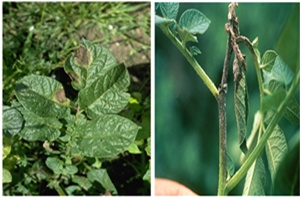
The symptoms or indications of late blight in potato have been associated with necrosis, black to brown lesions and mycelia growth creating sporangia on the leaves with water soaked lesions on stems, white growing lesions on the a biaxial leaf surface observed (Figure 1). On tubers, necrotic brown tissues are found near to the periderm formed after the sporangia washed from the infected leaves and stems (Hwang et al., 2014). Other symptoms at contaminated tubers are; reddish to purple and or copper to brown color appearance (Walker et al., 2007).
Life cycle and epidemiology of Phytophthora infestans
When potato leaf became diseased, the attacked photosynthetic tissue will be devastated causing less integrates, and reducing harvest in both quality and quantity. Tubers infected in the growing period can deteriorate in the course of storage due to late blight and secondary infections caused by other organisms. P. infestans could affect the complete parts of the potato plant excluding roots (Fehrmann and Dimond, 1967). Its life cycle will better be best understood based on the P. infestans reproduction phases, which are asexual and sexual types. In the asexual cycle of P. infestans, sporangia are developed on the affected leaf surface in moist weather and disseminated by wind or splashed by rainwater to other leaves. Presence of free water on the foliage and temperature of less than 16 °C, could lead to motile zoospores freed from sporangia. Together, sporangia, as well as zoospores, might infect the plants; however, zoospores are supposed to be more significant. The encyst zoospores produce germ tubes that swell to appressoria. An infection peg is shaped and the pathogen affects the plant by direct penetration via epidermal cells or by stomata. Subsequent to penetration, an infection vesicle is made and mycelium produces entirely at cellular positions, haustoria follow rarely. Few times subsequent to infection, the mycelium rises via the stomata openings by producing new sporangia (Grenville‐Briggs and Van West, 2005). The sporangia will be discharged once there is a fall in relative moisture level. Tubers are certainly affected in a rainy climate when the sporangia are splashed down and zoospores are freed to the soil. The released zoospores may go into the tubers via an injured lesions and natural openings (Robertson, 1991). Infected tubers could be regarded as inoculum bases and start an epidemic the following year.
For the sexual cycle, when both isolates of A1 and A2 mating types infects plants, sexual reproduction through oospore development might happen. Oospores are more abundantly established in the stems than in leaves, possibly since the stems withstand blight attack longer than foliage (Drenth et al., 1995). In lieu of the similar reason, additional oospores are formed on cultivars with average high resistance than at the susceptible cultivars (Hanson and Shattock, 1998). Once diseased plant residues drop to the ground and rot, the oospores are freed into the soil. Essentially, not much is well-known about oospore growth in the soil, likewise procedures by which potato plants are infected and injured by the oospores (Drenth et al., 1995). Sporangia, zoospores and non-pathogenic mycelia discovered within the soil are measured to live for a short time (Lehtinen and Hannukkala, 2004). This means that with no sexual reproduction, the pathogen is enforced to live among seasons as lively mycelium in the host plant part, i.e. tubers used for seeds, volunteers tubers left in the ground after harvest or heaps of leftover potato or waste (Shattock, 1976). Overwintering disease-ridden tubers in fields and waste loads are regarded as the most considerable first inoculum bases (Zwankhuizen, et al., 2000). In disparity to the asexually resultant spores, the sexually shaped oospores are more vigorous and can stay dormant in the soil. Consequently, in a P. infestans population having both the A1 and A2 mating types prevailing, the late blight fungus has an added persistence approach, independent on its host plant.
MANAGEMENT STRATEGIES OF POTATO LATE BLIGHT Phytophthora infestans
Numerous strategic management approaches of potato late blight has been utilized and used. Successful management of this devastating disease involves timely application of fungicides, use of resistance cultivars and other cultural practices. Integrating these disease management strategies will result in better control ability of the disease, thereby increasing both the yields and tubers qualities respectively.
Use of host resistance cultivars for the management of Phytophthora infestans
The use of host plant resistance cultivars in the control of P. infestans remains very essential in the integrated disease management due to its long-term cost-effective benefits to the farmers. Use of these resistance cultivars also reduces changes in the P. infestans population compositions and decreases every possibility of developing fungicide resistance (Namanda et al., 2004). Using host resistant cultivars is one of the efficient and environmentally less hazardous for the management of late blight. Consequently, breeding for late blight resistance varieties began in 19th century and has sustained at a slower level (Tsedaley, 2014). A disparity in the resistance to P. infestans between different potato cultivars has been confirmed by numerous scholars. However, cultivars with high late blight resistance can be damaged by new strains of P. infestans as the resistance is regulated by specific single gene. Certain varieties develop a minimal level of resistance which can provide various protections in drier seasons but offer slight benefits. P. infestans can be managed in moderately resistant cultivars controlled by minor genes together with abridged dose of fungicide. Varieties enduring high levels of resistance can let them to be grown in the nonexistence of chemical (free of chemical) protection even in the humid growing times (Tsedaley, 2014).
Use of resistance cultivars in the management of this disease is the key mechanisms and efficient especially in tropical environments. But, the race specific ologogenic resistance in the current released potato cultivars may fast broken by matching races of P. infestans making the cultivars to be more susceptible to the disease within the shortest period of time (Shitienberg et al., 1994). It is not wise to solely depend on varietal resistance for the management of P. infestans because favorable environmental condition can severely influence the resistance cultivars if not sprayed with a reliable synthetic protecting fungicide. These resistant cultivars have to be sprayed frequently with the fungicide to get rid of every possibility of unexpectedly damage caused by the races of the fungus that are not resistant to P. infestans (Tsedaley, 2014). Though, it is strongly recommended to make use of the resistance varieties, even where fungicide sprays was chosen as the main management strategy since resistant varieties delay the onset of the disease or else decrease its level of growth, thus less sprays may be required to control the disease (Agrios, 2005).
Cultural practices for the management of Phytophthora infestans
There are various cultural practices involved to control P. infestans worldwide, these practices are the principal protection mechanism of the disease (Kirk et al., 2013). Most of the cultural practices are employed with aim of decreasing the pathogen population, thereby reducing its survival rate, reproduction, spreading and entrance ability of the pathogen. Existence of P. infestans to initiate epidemic can be decreased by means of planting purely disease free potato seeds or tuber seeds that are certified and keep away from regular or nightly irrigation (Draper et al., 1994). The most active approach for managing late blight is avoiding inoculum sources. Therefore, removing cull heaps and volunteer potatoes by using appropriate harvesting and storage methods, and spraying fungicides when required, will provide a better way of reducing the disease. Other cultural methods includes removal of leftover tubers, hilling with sufficient amount of soil and adequate management of soil nutrient.
Keeping the field away from any conditions that will helps the P. infestans pathogen development is another way of managing the disease efficiently because climatic conditions strongly encourages its incidence and severity respectively. Moreover, it is of great advantage to clear weeds and other alternative P. infestans hosts like other Solanacea family that may probably influence the spread of the disease whenever the condition is favorable (Tsedaley, 2014). However, not all weeds are hosts to P. infestans pathogen, but they might be a factor to facilitate disease development through limiting air circulation within the potatoes canopy. Similarly, densely populated weeds prevent sufficient coverage of potatoes leaves while spraying fungicides (Kirk et al., 2013).
Chemical control for the management of Phytophthora infestans
Globally, the main control approach to constrain P. infestans prevalence and its brutality has been application of fungicides together with the use of host resistance cultivars (Cooke et al., 2011). In favorable environments for the development and survival of P. infestans, it has to be checked by weekly fungicide spray (Haverkort and Verhagen, 2008). Fungicides could only slow down or prevent the growth of new symptoms if applied in an appropriate time, but it will not alleviate existing symptoms of P. infestans. Thus, fungicide should be applied before the occurrence of the disease or at the initial onset of symptoms. Chemical fungicides constrain or decrease the progress of disease in plants through injuring pathogen cells membranes, deactivating vital enzymes required for their development and reproduction, thereby obstructing with the main life activities like energy production, upsetting metabolic paths such as production of chitin and sterols or by causing protection reactions in the host plants. While applying synthetic fungicides, comprehensive coverage of the whole potato plant including the leaves, stems, and canopy with fungicide is very essential to allow effective disease prevention, irrespective of the application techniques or sprays (Hirooka and Ishii, 2013). Regardless of the opinion that use of synthetic fungicides increases production expenses and has harmful effects on the environments and human safety, the effectiveness of fungicides is attractive to modest resource poor farmers and still remains the commonly used practice in nearly all developing nations (Forbes et al., 2007). Control of P. infestans has depended on rigorous fungicides application repeatedly without any suitable approach for resistance management. Nevertheless, the intensive usage of metalaxyl fungicide has been accountable for its decreased effectiveness worldwide (Rekanović et al., 2012).
The innovation of first systemic fungicides of the phenyl amide class metalaxyl, which was initially launched for sale around 1977, firstly delivered an excellent control of P. infestans (Kuck, and Gisi, 2007). Its advantages involve management of entire members of the Peronosporales and Pythiales, high systemic action, and an outstanding protection shape. Though severe application of metalaxyl led to the fast selection of metalaxyl-resistant strains of P. infestans around Europe in one year of its initiation, this is mainly owing to the usage of metalaxyl as a therapeutic fungicide on larger population of P. infestans (Parra and Ristaino, 2001). According to the declaration of Fungicide Resistance Action Committee (FRAC, 2012), P. infestans has established resistance to phenylamide synthetic fungicides very fast, yet not to iprovalicarb, fluazinam, dimethomorph, cymoxanil, azoxystrobin and fenamidone (QoI fungicides), cyazofamid (QiI fungicide), organotins and propamocarb. Consequently, FRAC re-classified P. infestans as a great- threat pathogen for the RNA polymerase target merely, also equally a medium- threat pathogen for all the other action modes (FRAC, 2012). Application of Ridomil MZ 63.5 % wettable powder (WP) fungicide at the rate of 2 kg /ha-1 followed by 2 to 3 different sprays of Dithane M-45 (Mancozeb) at the rate of 3 kg ha-1 was discovered to be efficient for the controlling of P. infestans (Mesfin and Giorgis, 2007).
CONCLUSION
Presently, there is global outcry and public concerns about deleterious effects of potato late blight disease that causes a huge damage to potato producers. This necessitates the search for viable alternatives for the sustainable management of the disease. This review has explained the detailed epidemiology and biology of P. infestans and integrated methods that could possibly be
exploited for effective management of Potato late blight. It also attributed difficulties in the control of the disease due to the emergence of new pathogenic races, and inadequate land for long-term crop rotation. Considering the important of potato to the human diet, it is therefore, necessary to find sustainable alternatives to control late blight of potato. The use of integrated disease management strategies may offer a sustainable solution to the management of potato late blight.
REFERENCES
Agrios G.N. (2005). Introduction to plant pathology Fifth edition. Elsevier Academic Press Publication, 2005.
Arora R., Khurana S.P. (2004). Major fungal and bacterial diseases of potato and their management. In Fruit and vegetable diseases, Springer, p. 189-231.
Arora R., Sharma S., Singh B. (2014). Late blight disease of potato and its management. Potato Journal, 41(1).
Birch P.R., Bryan G., Fenton B. (2012). Crops that feed the world 8: Potato: are the trends of increased global production sustainable. Food Security, 4: 477-508.
Bradshaw J.E., Ramsay G. (2009). Potato origin and production. Advances in potato chemistry and technology. Elsevier, p. 1-26.
Brown C.R., Culley D., Bonierbale M. (2007). Anthocyanin, carotenoid content, and antioxidant values in native South American potato cultivars. HortScience, 42: 1733-6.
Burruano S. (2000). The life-cycle of Plasmopara viticola, cause of downy mildew of vine. Mycologist, 14: 179-82.
Cavalier-Smith T. (2000). Membrane heredity and early chloroplast evolution. Trends in Plant Science, 5: 174-82.
Cohen Y., Farkash S., Reshit Z. (1997). Oospore production of Phytophthora infestans in potato and tomato leaves. Phytopathology, 87: 191-6.
Cooke L., Schepers H., Hermansen A., et al. (2011). Epidemiology and integrated control of potato late blight in Europe. Potato Research, 54: 183-222.
Devaux A., Kromann P., Ortiz O. (2014). Potatoes for sustainable global food security Journal of Potato Research, 57: 185-99.
Dick M.W. (2001). Criteria for diagnoses of flagellate fungi. Straminipilous Fungi. Springer. 2001: 11-99.
Draper M.A., Secor G.A., Gudmestad N.C. (1994). Leaf blight diseases of potato. NDSU Extension Service.
Drenth A., Janssen E.M., Govers F. (1995). Formation and survival of oospores of Phytophthora infestans under natural conditions. Plant Pathology, 44: 86-94.
FAOSTAT (2024). Available online: http://www. fao. org/faostat/en/# data [J]. QC (accessed on 15th September 2025).
Fehrmann H., Dimond A. (1967). Peroxidase activity and Phytophthora resistance in different organs of potato plant. Phytopathology, 57: 69-72.
Forbes G., Grünwald N., Mizubuti E. (2007). Potato late blight in developing countries.
Fry W. (2008). Phytophthora infestans: the plant (and R gene) destroyer. Journal of Molecular Plant Pathology, 9: 385-402.
Fry W.E., Goodwin S.B. (1997). Re-emergence of potato and tomato late blight in the United States. Plant Disease, 81: 1349-57.
Fungicide Resistance Action Committee, (FRAC) (2012). List of Pathogens with Field Resistance towards QoI fungicides. 2012. (accessed on December 20, 2025).
Gopal J., Khurana S. (2013). Handbook of potato production, improvement, and postharvest management. CRC Press, 2013.
Grenville‐Briggs L.J., Van West P. (2005). The biotrophic stages of oomycete–plant interactions. Advances in Applied Microbiology, 57: 217-43.
Guo L, Zhu X-Q, Hu C-H, et al. (2010). Genetic structure of Phytophthora infestans populations in China indicates multiple migration events. Phytopathology, 100: 997-1006.
Hanson K., Shattock R. (1998). Formation of oospores of Phytophthora infestans in cultivars of potato with different levels of race‐nonspecific resistance. Plant Pathology, 47: 123-9.
Haverkort A., Verhagen A. (2008). Climate change and its repercussions for the potato supply chain. Potato research, 51: 223.
Hijmans R.J. (2001). Global distribution of the potato crop. American Journal of Potato Research, 78: 403-12.
Hirooka T., Ishii H. (2013). Chemical control of plant diseases. Journal of General Plant Pathology, 79: 390-401.
Hwang Y.T., Wijekoon C., Kalischuk M. (2014). Evolution and management of the Irish potato famine pathogen Phytophthora infestans in Canada and the United States. American Journal of Potato Research, 91: 579-93.
Jansky, S., Dempewolf, H. and Camadro, E. L. (2013). A case for crop wild relative preservation and use in potato. Journal of Crop Science, 53(3): 746-54.
Karpov S.A. (2000). Flagellate phylogeny. The flagellates: Unity, Diversity and Evolution, 2000, 336.
Kaukoranta, T. (1996). Impact of global warming on potato late blight: risk, yield loss and control. Journal of Agricultural and Food Science, 5: 311-27.
Kirk W., Wharton P., Hammerschmidt R., et al. (2013). Late blight. Michigan state university extension bulletin E-2945 East Lansing.
Kuck K.H., Gisi U. (2007). Fungicide Resistance Action Committee (FRAC) mode of action classification and resistance risk of fungicides. Modern Crop Protection Compounds, 2: 415-32.
Lamou K.H., Win J., Kamoun S. (2007). Oomycete genomics: new insights and future directions. FEMS Microbiology Letters, 274: 1-8.
Lehtinen A., Hannukkala A. (2004). Oospores of Phytphthora infestans in soil provide an important new source of primary inoculum in Finland. Journal of Agricultural and Food Science, 13: 399-410.
Liu D., Anderson N.A., Kinkel L.L. (1996). Selection and characterization of strains of Streptomyces suppressive to the potato scab pathogen. Canadian Journal of Microbiology, 42: 487-502.
Meinck S., Kolbe H. (1999). Control of leaf and tuber blight in ecological potato cultivation. Kartoffelbau, 50: 172-5.
Mesfin T., Giorgis G. (2007). Impact of farmers’ selected IDM options on potato late blight control and yield; proceedings of the 8th African Crop Science Society Conference, El-Minia, Egypt, 27-31 October 2007. African Crop Science Society.
Namanda S., Olanya O., Adipala E., et al. (2004). Fungicide application and host-resistance for potato late blight management: benefits assessment from on-farm studies in SW Uganda. Crop Protection, 23: 1075-83.
Parra G., Ristaino J.B. (2001). Resistance to mefenoxam and metalaxyl among field isolates of Phytophthora capsici causing Phytophthora blight of bell pepper. Plant Disease, 85: 1069-75.
Rekanović E., Potočnik I., Milijašević-Marčić S. et al. (2012). Toxicity of metalaxyl, azoxystrobin, dimethomorph, cymoxanil, zoxamide and mancozeb to Phytophthora infestans isolates from Serbia. Journal of Environmental Science and Health, Part B, 47: 403-9.
Robertson N. (1991). Challenge of Phytophthora infestans. Advances in Plant Pathology, 235.
Shattock R. (1976). Winter survival of field isolates of Phytophthora infestans in seed tubers and development of primarily infected plants. Annals of Applied Biology, 84: 273-4.
Shitienberg D., Bergeron S., Legard D. (1994). Incorporation of cultivar resistance in a reduced-sprays strategy to suppress early and late blights on potato. Plant Disease (USA),1994.
Sparrow F. (1979). The present status of classification in biflagellate fungi. Recent Advances in Aquatic Mycology, 213-22.
Spooner D.M.,Hijmans R.J. (2001). Potato systematics and germplasm collecting, 1989–2000, American Journal of Potato Research, 78: 237.
Spooner D.M., Ghislain M., Simon R. (2014). Systematics, diversity, genetics, and evolution of wild and cultivated potatoes. The botanical review, 80: 283-383.
Spooner D.M., Van Den Berg R.G., Rodrigues A. (2004). Wild potatoes (Solanum section Petota; Solanaceae) of North and Central America .The American Society of Plant Taxonomists, 2004.
Tian Y. Yin J., Sun J. et al. (2015). Population structure of the late blight pathogen Phytophthora infestans in a potato germplasm nursery in two consecutive years. Phytopathology, 105: 771-7.
Tsedaley B. (2014). Late blight of potato (Phytophthora infestans) biology, economic importance and its management approaches. Journal of Biology, Agriculture and Healthcare, 4: 215-25.
Van Den Berg R., Groendijk-Wilders N. (2014) Taxonomy of potato: Botany Production and Uses, CABI Publishing, Surrey, 12-28.
Vanegtern B., Rogers M., Nelson S. (2015). Black pod rot of cacao caused by Phytophthora palmivora. Plant Disease, 108: 1-5.
Walker C.A., Van West P. (2007). Zoospore development in the oomycetes. Fungal Biology Reviews, 21: 10-8.
Wang Q, Zhang W. (2004). China’s potato industry and potential impacts on the global market American Journal of Potato Research, 81: 101-9.
Yabuuchi E., Kosako Y., Yano I. (1995). Transfer of Two Burkholderia and An Alcaligenes Species to Ralstonia Gen. Nov. Proposal of Ralstonia pickettii and Nov., Ralstonia solanacearum. Microbiology and Immunology, 39: 897-904.
Yuan S., Liu X., Si N. (2006). Sensitivity of Phytophthora infestans to flumorph: in vitro determination of baseline sensitivity and the risk of resistance. Plant Pathology, 55: 258-63.
Zwankhuizen M., Govers F., Zadoks J. (2000). Inoculum sources and genotypic diversity of Phytophthora infestans in Southern Flevoland, the Netherlands. European Journal of Plant Pathology, 106: 667-80.